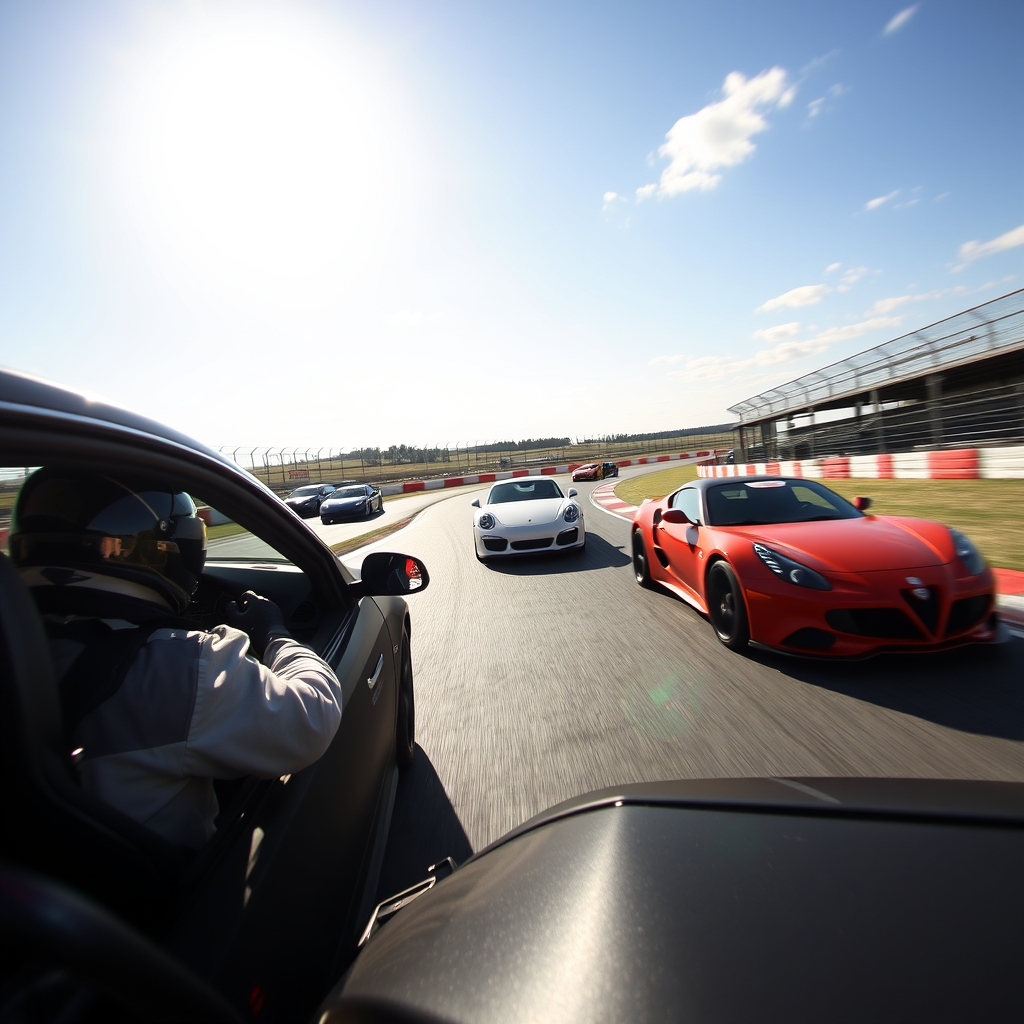
The On-Track Coverage Gap Is Real
Every standard auto insurance policy contains language like this somewhere in its exclusions section:
*"This policy does not apply to bodily injury or property damage arising out of the ownership, maintenance or use of any vehicle while being used in a prearranged or organized race, speed contest, demolition derby, or stunt activity."*
Or:
*"We do not provide coverage for any vehicle used on a racetrack, closed course, or other facility where organized racing, speed testing, or vehicle performance contests are conducted."*
Read your policy. Find the exclusion. It's there.
This exclusion means that when you pull through the paddock gate at a track day, HPDE event, or open track session, your auto insurance stops covering your car for on-track incidents. If you slide into a wall on a hot lap, you're paying out of pocket.
Most HPDE participants don't know this. Many assume that because HPDE is educational (not racing), it's somehow different. For most insurance policies, it isn't.
HPDE Is Not "Racing" — But That May Not Matter
High Performance Driving Education (HPDE) events are structured as instruction, not competition. There are instructors in the car, there's no timing, there's no passing under braking (usually). Participants aren't racing.
But the insurance exclusion usually doesn't say "racing." It says "racetrack," "closed course," "track facility," or "organized vehicle performance events." HPDE events happen on racetracks, are organized, and involve vehicle performance. Most insurers don't make a distinction between HPDE and competitive track events — both happen on closed courses, and both are excluded.
There are some specialty carriers that write street policies with more lenient track use language. A small number of enthusiast insurers explicitly permit HPDE with instructors present. These policies exist, but they're not the standard, and they often carry conditions (instructor requirement, no timed sessions, specific speed limits).
The practical rule: assume your policy excludes on-track use unless you have confirmed written documentation that it doesn't.
What YOUR Policy Actually Covers at a Track Event
Even with the on-track exclusion, your coverage doesn't disappear entirely at a track event. It stops specifically for on-track driving:
Transport to the event: Your car is covered while being driven or trailered to the track venue. Highway incident, street accident — covered normally.
Paddock and pit area: While your car is parked in the paddock, staged before a run, or being worked on in the pit — you have comprehensive coverage. Fire, theft, vandalism, weather events in the paddock are comprehensive claims.
Incident in the parking lot or public areas: If something happens in the public parking lot before you enter the gated paddock, it's a standard auto claim.
Return trip home: Same as transport to the event — fully covered.
The coverage stops when you drive through the timing lights (or equivalent entry point) for an on-track session and resumes when you return to the paddock.
On-Track Physical Damage: Your Options
Several products exist for on-track physical damage. None of them are your standard auto policy.
Option 1: Per-Event Track Day Insurance
Per-event policies cover physical damage to your car during a specific track event. You buy coverage for that event, and it's valid for the day(s) of the event.
Providers: Lockton Motorsports, Competition Insurance Associates (CIA), Open Track Insurance.
Coverage: Physical damage to your car while on track. Liability to other participants is typically available as an add-on.
Cost: Typically $150–$400 per event depending on the car's value, the event, and coverage limits chosen.
Best for: Occasional track participants — 1–4 events per year. The math doesn't support per-event coverage for frequent participants.
How it works: You declare the car's value, pay the per-event premium, and the policy is active for the event dates. Simple.
Option 2: Annual Track Day Policy
Annual policies provide on-track physical damage coverage for an entire season of events without needing to buy per-event coverage each time.
Cost: Typically $500–$2,000+ per year depending on car value and annual event frequency.
Best for: Regular HPDE participants — 5+ events per year, or any participant for whom per-event math becomes costly.
Advantage: Simpler — no need to remember to buy event coverage, no gaps if you add a last-minute event.
Option 3: Some Classic/Specialty Carriers with Track Use Language
A small number of specialty carriers explicitly include limited HPDE/track use in their policies. These typically require: - Instructor present in the car (novice run groups) - No timed or speed contest events - Approved track facilities
If you're in a beginner HPDE program where an instructor rides along for every session, ask specifically about this option.
Option 4: Self-Insurance
Many experienced track day drivers — especially those with lower-value track cars — accept the on-track risk and don't buy event coverage. If your track car is a $5,000 Miata, the economics of per-event coverage (at $150–$400 per event) become questionable versus just absorbing the risk of a lower-value incident.
This is a legitimate choice for experienced drivers in appropriate cars. It's not a coverage solution — it's a conscious decision to bear on-track risk out of pocket.
Liability on Track: Who Pays When You Hit Someone?
This question comes up constantly. You spin and tag another car on track. Who pays?
The answer has two parts:
Your liability for the other car's damage: Standard HPDE events operate under a "no-fault" or "participants assume risk" framework. You are generally not liable to other participants for on-track incidents — the other driver assumed the risk of track use by entering. This doesn't mean you can never be liable (gross negligence or recklessness is different), but typical track contact claims are handled between the participants' own coverage.
The other driver's liability for your car's damage: Same analysis in reverse. If another driver tags your car on track, their standard liability coverage doesn't apply (on-track exclusion), and the no-fault framework means you're not pursuing them. Your on-track physical damage coverage (if you have it) pays for your car.
The key insight: on-track incidents are generally handled through each driver's own coverage (if they have event coverage), not through liability claims against each other. If you don't have event coverage, on-track damage is out of pocket.
Building the Right Coverage Stack
For a typical HPDE participant who also drives their track car on the street:
Layer 1 — Specialty agreed value street policy: Covers the car from your garage to the paddock and back. All off-track use. If your car has significant modifications, agreed value is essential (see our Modified Car Insurance guide).
Layer 2 — Per-event or annual track coverage: Covers the car while on track during events.
Together, these create complete coverage. Neither gaps the other.
Cost example: A $25,000 modified track car might run $800/year for agreed value street coverage + $400/event for 4 events per year ($1,600 event coverage) = $2,400/year total for complete coverage both on and off track.
Before Your Next Track Day
If you're attending an HPDE event and haven't thought through this:
1. Call your insurer and ask specifically: "Does my policy cover my car while driving on a racetrack or closed course in an HPDE event?" Get the answer in writing (email is fine).
2. Look at per-event coverage through Lockton Motorsports or CIA. If your car is worth more than $5,000 and you wouldn't write a check that size without feeling it, consider per-event coverage.
3. Know what you're risking: If you go on track without event coverage, be clear-eyed about what you're accepting. That's a legitimate choice — just make it intentionally, not by accident.
4. Talk to us about your street policy: If you have significant mods on your track car and are on a standard ACV policy, the on-track coverage problem is actually the second issue. The bigger problem is that your street coverage doesn't protect your modifications either. Fix that first.
Call 844-967-5247 to discuss your modified car's coverage stack — both on and off the track.